
I thought good hosting meant not “imposing” on others.
Oh, how wrong I was.
Over the past few days, I have been doing a deep dive into what it means to host a gathering, and I realised how limiting my views were.
Before, I assumed a good host was accommodating and easygoing - the type who says “do whatever you like” and means it from their carefree nature. They don’t interfere or impose; they set the table, take a step back and let the night be shaped by the people around.
This is horrible.
This is not what we people want.
We don’t want to have uncertainty, we like structure and order, and we don’t want to have to think of the next remotely interesting conversation starter.
I have been hiding in my room in absolute awe of what I have learnt.
I realised that as a host you should impose…
Some of the best gatherings have been when the host built a temporary world.
The first person who comes to mind is Poppy. You see, Poppy was my women’s fencing captain for 25/26 and hosted some of the best socials I have ever attended. They weren’t the biggest or most expensive; they were full of genuine connection.
One of the socials was a gingerbread-house-making gathering, but she imposed constraints. She wrote riddles that we had to decipher and find the location of each key to unlock a gingerbread piece - we, as a team, had to earn it.

Team A

Team B
She built a temporary world where she made the rules, and we conformed to them completely; nobody checked their phones except to use the notes app and get a copy of the alphabet. Nobody had to do the rather exhausting work of deciding what kind of evening it could be like or what to talk about, as our dearest Poppy had already decided.

The riddles in question.
Poppy decided the rules, theme, tone, constraints and the direction of the gathering - this was a gift.
If she hadn’t done that, what would have probably happened?
The room wouldn’t have been “shaped”, and everyone likely would have defaulted to their ordinary social behaviour. How boring. If everyone is running ordinary behaviour, no one would be the first “to break the script,” so the room would stay safe and rather flat.
Politeness as a host looks like leaving people free to exist, but it is actually leaving people to fend for themselves.
I have concluded that being too polite is one of the worst things a host can do.
An architecture firm threw a “cage match” because no one raised their opinions.
Priya Parker, the author of The Art of Gathering, described an architecture firm that couldn’t decide which direction to take (architectural vs design-oriented).
The room itself was full of disagreement, but paradoxically, you never would have known because nobody felt comfortable enough to voice their opinions aloud.
Do you see the problem?
Conformity because “old scripts” in social settings aren’t broken for people to feel free to express themselves.
Perhaps there is nothing wrong with the architects themselves; maybe somebody had failed to host them.
So they hosted good controversy.
After a lunch break, the architects came back to a temporary world of a “cage match.”
They formed two teams, each with one nominated “fighter.”
Team 1 - represented design
Team 2 - represented architecture.

Example photo of a debate team.
They even had someone assigned as a Don King-style manager to hype up the fighters and arm them with counterarguments, while white towels were slung around their necks with Rocky music playing to set the ambience.
The other architects had to stand up and physically walk to the team that matched their opinion.
Team 2 won.
I absolutely love this story, as it's profound how such a serious question was settled by something that looked, from the outside, so unserious and fun.
The room became more artificial than before as people were handed constraints and rules instead of freedom, with people assigned rules and forced to pick a side. Ironically, it produced more honesty than when they had free rein to speak up but never did.
Priya Parker’s philosophy that a gathering creates a temporary alternative world is beautiful. This “alternative” world is what makes the true thing sayable, as it is said by a character you are playing rather than you, on a random Friday in front of the executive team.
Perhaps good hosting isn't eliminating danger and discomfort, but curating it by building a container strong enough to hold a little “heat.”
“The norm of politeness was blocking their progress.”
This is Priya Parker's diagnosis of the situation, and I can’t stop staring at it.
The cage match did not create the disagreement; it provided a healthy container for it. A room with no visible conflict isn't always healthy; it can look perfectly pleasant while every person in it is actively swallowing what they really think—an absolute disgrace.
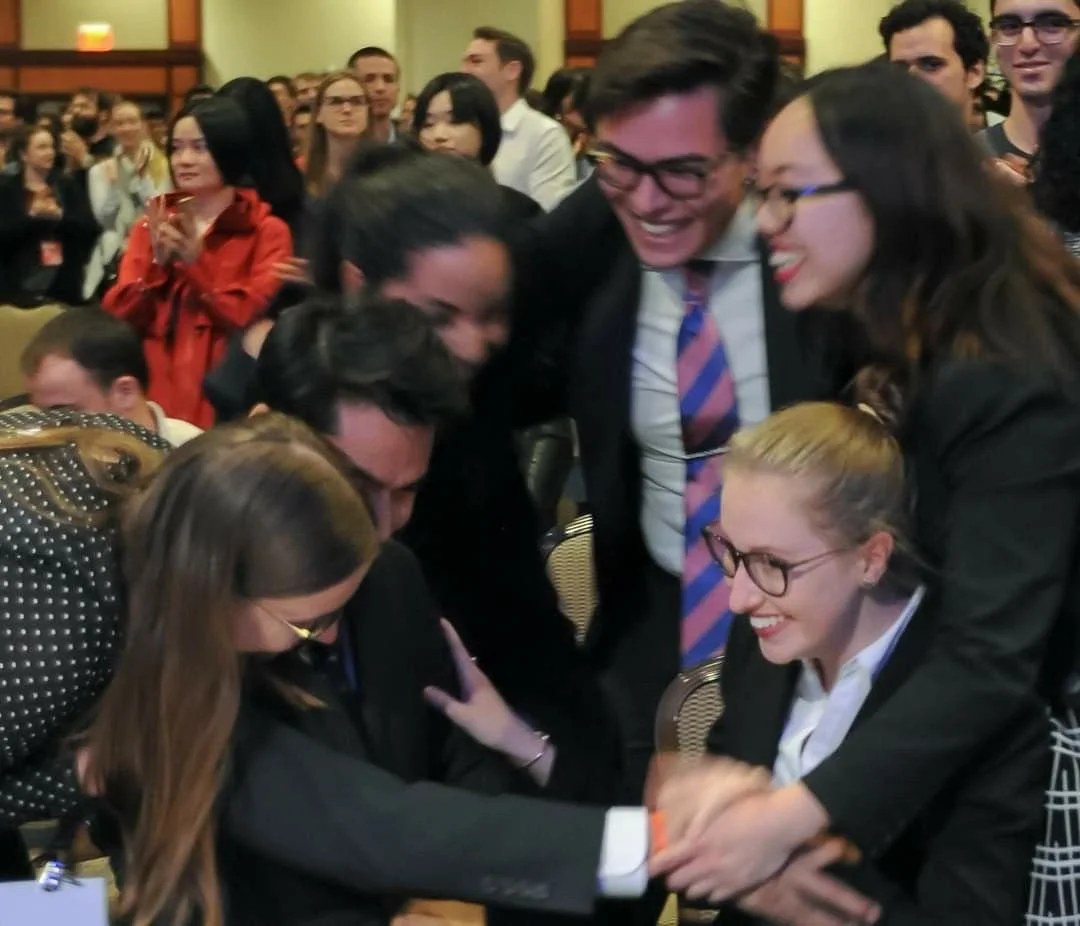
Example photo of what bringing together for a shared notion can do.
What did the host build in this architecture firm?
Rules. Sides. Permission. Structure. A theatrical frame. A contained space where you could argue without it becoming personal. Most importantly, it was wildly entertaining.
It made me consider dentistry as a field as a whole (context - I am a dental student at university) and realised we have an enormous volume of unspoken opinions about how things are running and the future trajectory of the field… but no truly effective space in which any of it gets said without fear of judgment.

We, dental care professionals, are extraordinarily polite, and Priya Parker’s phrase for what good controversy does is that “it gives people a way into each other without burning the house down” - exactly what I find is missing in the field.
Is “everybody had a lovely time” really the desire we want to achieve?
For me, no way. Not for a second.
Every gathering I consider overall follows the same scripts and shapes; I have had enough. I want to breathe in fresh air, not old.
My deep desire is to arrive as one person and leave with a slightly different sense of self, shaped by enlightenment from something that implicitly or explicitly challenged my views. To hear different views I hadn’t considered, for the better or worse and sit with it and see if I see value in my perceptions on the matter. To leave with new questions and enquiries that I feel the urge to frantically type on my notes app.
The architects didn’t remember that afternoon because everyone ended up agreeing and sang in harmony; it was the complete opposite. Each team member had to locate where they stood, hear the other side properly, and then make their position visible by physically moving their bodies across the room.
You can’t do that on autopilot, which is exactly the whole point.
Hosting looks so different in my mind now.
I now think a host sometimes has to inconvenience people to give them access to one another and create a container for human connection.
Notes for the next event I host.
Artemis,
The question you should ask yourself is, “How much inconvenience is required to get a room away from autopilot behaviour?”
Build the container before you introduce the heat (if that is a need for the event): rules, roles, a frame, an end point.
State a purpose in the invitation. Not a time and a place. A reason. Prime them before they arrive.
Things I haven’t worked out yet.
How do you generate heat in a group with no shared history?
Poppy had a fencing team, and the firm had colleagues who’d been avoiding each other for months. What do you do with strangers, though?
When a guest says something that stops the whole table, what does a good host do in that situation?
